
Brazil’s leading presidential candidates took the debate stage on Sunday, one week before the October 25 run-off elections. While the two traded barbs, the debate offered little in the way of substance for Brazilian voters, who are concerned about everything from healthcare, to education and public security, according to a recent Datafolha poll.
On one side, the incumbent, left-wing President Luiz Inácio Lula da Silva, is seeking a fourth term as president of Latin America’s largest country. On the other, right-wing Senator Flávio Bolsonaro, the son of former President Jair Bolsonaro who was jailed for coup plotting, aims to reestablish the family’s power amid scandals.
What is traditionally a democratic forum for debating public policy instead devolved into a competition aimed at revealing one another’s closeted skeletons. The debate was also filled with misleading claims and misinformation, which were subsequently challenged by independent fact-checkers.
At one point, Lula refused to stand next to Bolsonaro on the debate stage, calling him a “militiaman.” Bolsonaro fired back, saying, “I don’t have my wallet here, so you won’t be able to steal from me,” insinuating Lula is a thief.
In a separate exchange, Bolsonaro questioned why 73% of prisoners had allegedly voted for Lula. The president sarcastically replied, “I want 100%, including your father’s vote.”
Despite the heated exchanges, neither candidate offered much detail on how they would combat corruption, one of the key concerns for Brazilian voters in this year’s elections.
Regarding Brazil’s economy, proposals also fell short on detail. Bolsonaro promised to create a Ministry of Prosperity to tackle household debt, while Lula defended existing programs such as Desenrola, an individual debt renegotiation program from the federral government.
Neither candidate clearly explained how they would address Brazil’s high interest rates, growing public debt or fiscal pressures, leaving voters with more promises than concrete plans.
The debate also laid bare a deeper issue facing Brazil’s democracy: a growing disconnect between voters and the candidates.
Lula is running for an historic fourth term as president of Brazil and came in second place to Bolsonaro in the first round of elections on October 4. Flavío Bolsonaro, on the other hand, is the political heir to one of the most controversial presidents in South America who is currently serving his 27-year sentence on house arrest following health issues.
Both candidates share unfavorable perceptions from the public, with a recent Datafolha survey finding a 46% voter rejection rate for Lula and 44% for Bolsonaro.
Meanwhile, recent research conducted by Real Time Data on October 20, showed that 28% of voters rejected both candidates.
Moreover, voter abstention in the first round exceeded 21%, up slightly from 20.95% in 2022, despite voting being mandatory.
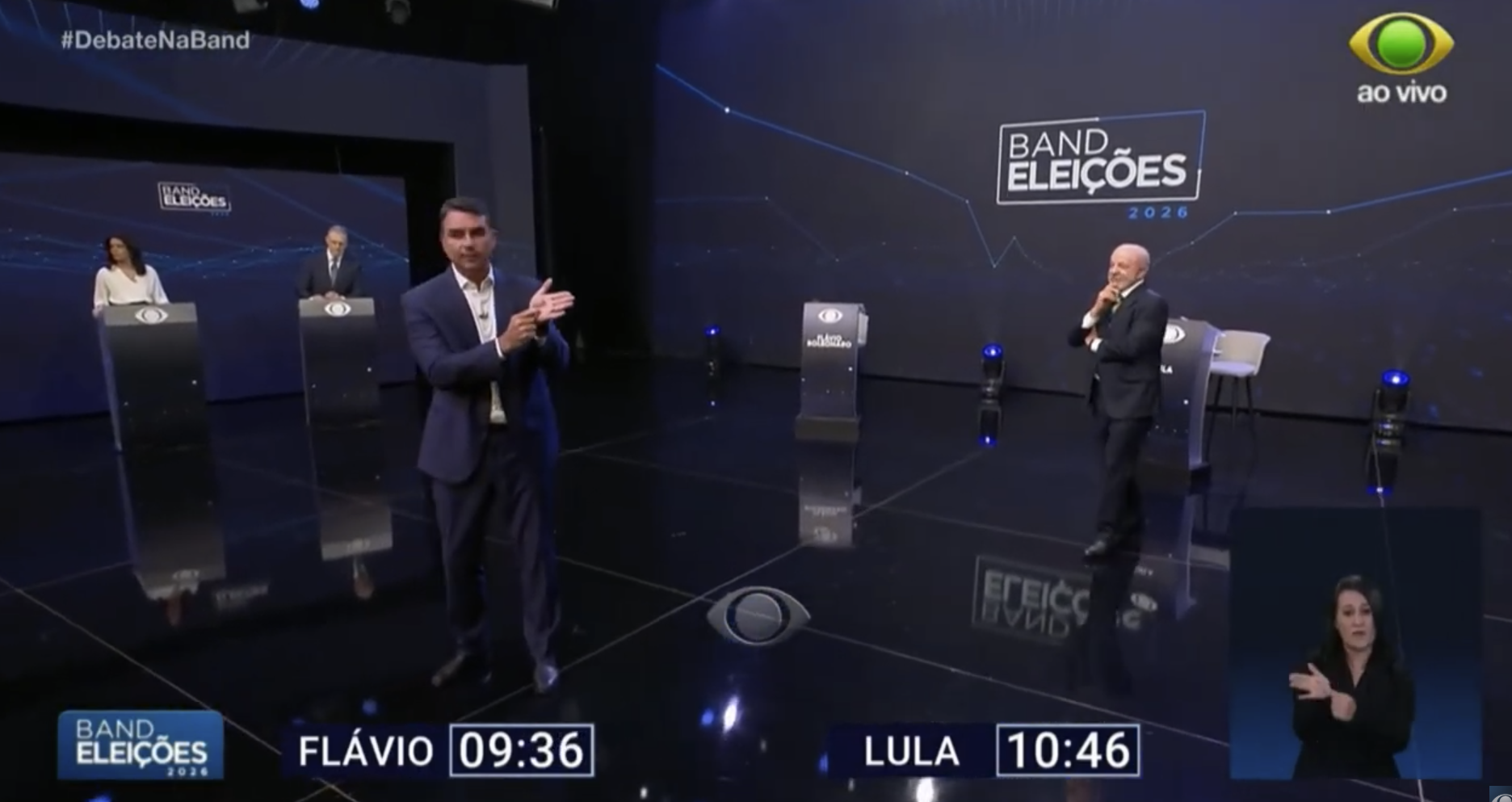
Featured image: During a heated presidential debate on October 18, 2026, Flavío Bolsonaro wrote “Corrupt” on his hand, referring to his opponent, Luiz Inácio Lula da Silva.
Image credit: Screenshot of video of debate from Band Jornalismo via YouTube.