
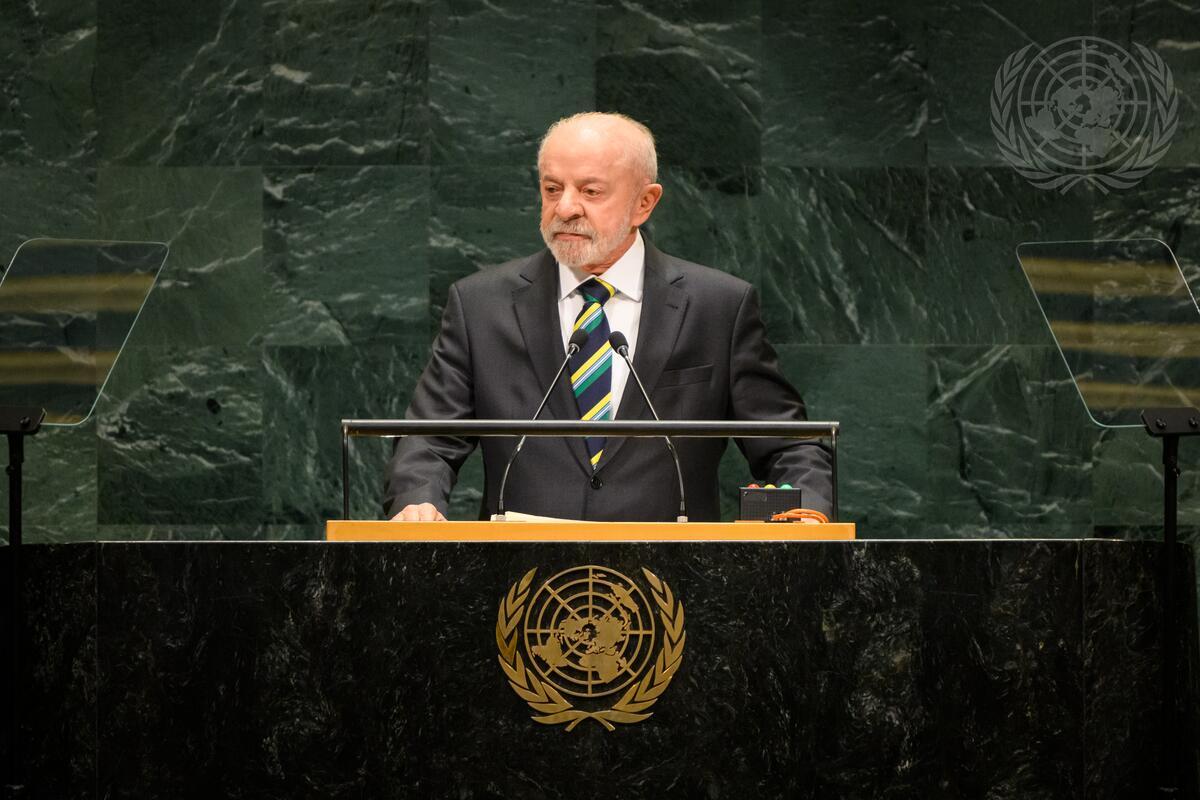

São Paulo, Brazil — Brazil’s President Luiz Inácio Lula da Silva used his address to the United Nations General Assembly in New York City on Tuesday to deliver a broad defense of national sovereignty, while sharply criticizing Israel’s conduct in Gaza, the use of tariffs as political leverage, and what he described as renewed attempts by powerful countries to interfere in Latin America.
Speaking less than two weeks before Brazil’s October 4 election, Lula said the international system was facing its most serious crisis since he first addressed the General Assembly in 2003. He argued that the UN had become increasingly unable to contain wars or protect countries and populations with little geopolitical power.
“The UN is failing in one of its highest missions: to rid the world, humanity, of the scourge of war,” Lula said. “Its credibility has never been so low. Its ability to protect the most vulnerable, those who have neither armies nor arsenals, has never been so limited.”
Lula placed much of the responsibility on the UN Security Council, saying the international community had become hostage to a body that “does not fulfill its role.” He also criticized the veto power held by its five permanent members and called on their leaders to meet as geopolitical tensions intensify.
“I do not ignore the realities of power, but concessions to the law of the strongest have gone too far,” he said. “This is not idealism. It is pure realism. War is not the continuation of politics by other means; it is the total failure of politics.”
Gaza, Israel and the wars reshaping the international order
The war in Gaza occupied a central part of Lula’s address. The Brazilian president invoked former Palestinian leader Yasser Arafat and former Israeli Prime Minister Yitzhak Rabin as political figures who attempted to overcome decades of conflict before turning to the current war.
“Generations of Palestinians will carry the pain and trauma left by the genocide committed by the Netanyahu government against women and children in Gaza,” Lula said.
He also condemned Hamas’ attacks against Israelis. “Israeli civilians paid the price for the radicalism and intolerance of Hamas’ terrorist acts,” he said.
Brazil has been one of the governments most openly critical of Israeli Prime Minister Netanyahu’s conduct in the war. At the UN, Lula also criticized pressure against the International Criminal Court and defended Francesca Albanese, the UN special rapporteur on the occupied Palestinian territories.
“Persecuting the International Criminal Court and its members is an incentive for these crimes to go unpunished,” Lula said. “UN Special Rapporteur Francesca Albanese cannot be silenced for telling the truth.”
He argued that Israeli settlements in the West Bank are making a two-state solution increasingly difficult, while reiterating Brazil’s support for an arrangement under which Israel and a Palestinian state could coexist.
Lula then widened the argument beyond Gaza. He pointed to instability in the Strait of Hormuz and its impact on global fuel, fertilizer and food prices, and said the war between Russia and Ukraine could not be resolved militarily.
“We all know that there will be no winners on the battlefield. Diplomacy is the only option,” he said, citing the Friends for Peace initiative created by Brazil and China as an effort to promote negotiations.
‘Brazil does not belong in anyone’s backyard’
Some of Lula’s strongest language came as he turned to Latin America and the relationship between the region and major powers.
“In Latin America and the Caribbean, geographic proximity to the world’s greatest military power is inescapable, especially in a context of renewed hegemonic ambitions,” he said. “Brazil does not belong in anyone’s backyard.”
Lula did not name the United States in that sentence, but immediately argued that Brazil needs partners willing to promote development rather than relationships based on ideological alignment.
“We need partners with a positive agenda that fosters development. Ideological differences should not be obstacles to greater integration among neighbors,” he said.
The remarks came as Lula warned of renewed foreign interference in Latin American politics. “Democracy is once again under threat. We are once again witnessing external interference in electoral processes,” he said. “The division of the world into spheres of influence and neocolonial attempts to seize strategic resources are anachronistic gestures.”
His comments covered governments across the ideological spectrum. Lula said Venezuelans should determine their own future, but also directly criticized Nicaragua’s restrictions on political competition.
“The Venezuelan people deserve to define their own destiny. Nicaragua will not solve its problems by preventing the opposition from contesting elections,” he said.
He also criticized the economic embargo on Cuba and described the continuing crisis in Haiti as another test of the international community’s willingness to act.
Organized crime and cooperation with the United States
Lula also used the speech to set limits on the kind of international cooperation Brazil is willing to accept in fighting organized crime.
Brazil, he said, does not underestimate the threat posed by criminal organizations and is prepared to confront groups that terrorize communities. But he rejected the idea that the country should rely on foreign military power to secure its territory.
“We will not outsource the responsibility of defending our borders and guaranteeing our people the right to live without fear,” Lula said. “We do not need aircraft carriers patrolling our waters. We need cooperation to stop the flow of weapons and money that supplies organized crime.”
According to Lula, that principle formed the basis of a proposal he personally presented to the president of the United States. He said Brazil wants greater cooperation against the laundering abroad of money generated by Brazilian criminal organizations.
The president also highlighted efforts to improve coordination among Brazil’s security forces, including the International Police Cooperation Center for the Amazon in Manaus, which brings together Brazilian agencies and representatives from other Amazon countries.
“Organized crime and corruption go together,” Lula said. “Fighting corruption is what we have to do. […] No one is above the law.”
Tariffs, trade and strategic resources
Without naming a country in this section of the address, Lula also criticized governments that use tariffs to pressure other states.
“The World Trade Organization is on life support,” he said. “When governments capitulate to those who use tariffs as a weapon of coercion and blackmail, the consequences are disastrous.”
Later, while discussing Brazil’s economic performance, Lula said the country was on course to set a new export record “despite the tariff offensive against our economy.”
The president linked his defense of sovereignty to another increasingly important geopolitical dispute: access to critical minerals and rare earth elements.
Brazil has significant mineral resources used in advanced manufacturing and the energy transition. Lula said access to those reserves would be conditioned on economic benefits remaining inside the country.
“Our natural wealth belongs to the Brazilian people, and it will be exploited for their benefit,” he said.
“Access to our minerals will require, as a mandatory counterpart, the generation of value within our territory, technology transfer and the supply of strategic domestic sectors.”
Lula also defended continued research into new oil reserves, specifically mentioning Brazil’s Equatorial Margin, while arguing that further exploration would not mean abandoning the country’s environmental commitments.
“We will continue researching the potential of new reserves, such as those on the Equatorial Margin,” he said. “We will not abandon the environmental agenda.”
Big Tech, artificial intelligence and Brazil’s Pix
Technology policy also featured prominently in the speech. Lula called for stronger regulation of major digital platforms and artificial intelligence, arguing that governments cannot allow technological development to advance without ethical or legal constraints.
He said regulation should protect children, adolescents and women online, while also ensuring that artists, musicians and content producers are compensated for the use of their work.
Lula separately targeted Brazil’s rapidly expanding online betting industry.
“The billion-dollar betting industry turns addiction into profit,” he said. “Its rapid spread is driving millions of households into debt and destroying them. Brazil will not tolerate this business model.”
He also defended Pix, the instant-payment system created and operated by Brazil’s Central Bank, against what he described as pressure from multinational companies.
“We will not give in to pressure from multinationals that want to privatize our Pix, a public and free payment infrastructure that has made financial inclusion a reality for millions of Brazilians,” Lula said.
Election becomes part of Lula’s UN message
Lula closed the address by turning directly to Brazil’s October 4 election, framing the vote as a choice that went beyond the candidates running for the presidency, state governments and Congress.
“On October 4, millions of Brazilian men and women will go to the polls to define their destiny,” he said. “They will decide between democracy and denialism. Whether Brazil will move forward toward a future with more opportunities or return to a past of exclusion.”
Lula said the election would be “transparent and competitive” and that candidates were free to express their views. He then accused unnamed political actors of using that freedom to align themselves with foreign interests.
“We know that some abuse this freedom to associate themselves with foreign interests that run counter to the country,” he said. “We do not underestimate the challenge posed by the disinformation network that seeks to distort public debate during the campaign.”
He ended by defending Brazil’s electronic voting system and returning to the sovereignty argument that ran through much of his address.
“We have a modern and robust electoral system,” Lula said. “Under the watchful eyes of a pluralistic citizenry and a free press, we will not allow the enemies of democracy, internal or external, to undermine the will of the people.”
“Brazilian democracy belongs to Brazilians,” he added. “Brazil will continue to be a sovereign country. No one, no one will divert us from this path.
Featured image: Brazil’s President Luiz Inácio Lula da Silva addresses the United Nations General Assembly in New York City on September 22, 2026.
Image credit: United Nations